Planning your first trip to Japan?
Japan is clean, safe, efficient, and full of amazing places to explore. But for first-time visitors, small things like train exits, IC cards, cash-only shops, luggage, and local manners can still feel confusing.
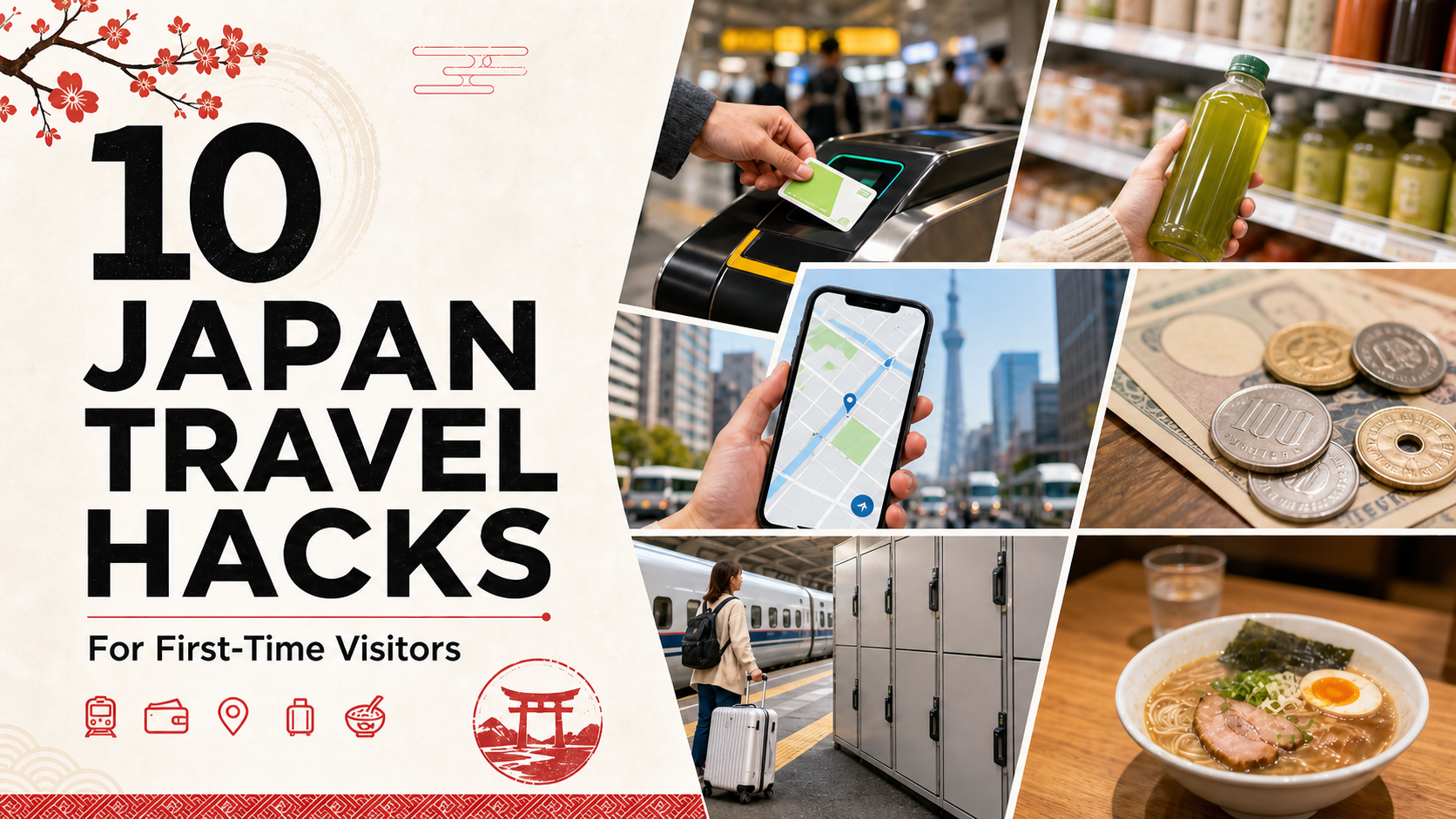
Here are 10 simple Japan travel hacks that can save you time, reduce stress, and help you enjoy your trip with more confidence.
Quick Summary
- Get an IC card
- Use convenience stores
- Carry some cash
- Check the station exit number
- Learn “sumimasen”
- 1. Get an IC Card for Easier Travel
- 2. Use Convenience Stores Like a Travel Support Center
- 3. Carry Some Cash and Coins
- 4. Use Google Maps, But Always Check the Exit Number
- 5. Learn “Sumimasen”
- 6. Avoid Eating While Walking in Busy Areas
- 7. Use Luggage Delivery When Moving Between Cities
- 8. Book Popular Restaurants Early
- 9. Use Coin Lockers at Stations
- 10. Know Basic Train Etiquette
- Final Thoughts
1. Get an IC Card for Easier Travel
Visitor-friendly IC cards such as Welcome Suica or TOURIST PASMO may be available depending on when and where you arrive. Availability can change, so check official information before your trip.
💡JAPAN HACK
If you arrive at Narita or Haneda, check for a visitor-friendly IC card before leaving the airport. It can save you time not only on trains and buses, but also for small purchases during your trip.
2. Use Convenience Stores Like a Travel Support Center
Japanese convenience stores are incredibly useful for travelers. You can buy quick meals, drinks, umbrellas, charging cables, toiletries, socks, and other daily essentials.
Many convenience stores also have ATMs that work with international cards, which can be helpful when you need cash late at night or before an early train.
💡JAPAN HACK
If something small goes wrong during your trip, try a convenience store first. Food, cash, rain goods, and daily essentials are usually easy to find there.
3. Carry Some Cash and Coins
Japan is becoming more cashless, but cash is still useful. Some small restaurants, local shops, temples, shrines, buses, vending machines, and older coin lockers may not accept cards.
You do not need to carry a huge amount. For most visitors, keeping a few thousand yen to around 10,000 yen is enough for small cash-only situations.
💡JAPAN HACK
Do not travel in Japan with only a credit card. Keep some cash and coins so you do not get stuck in cash-only places.
4. Use Google Maps, But Always Check the Exit Number
Google Maps is very useful in Japan, especially for train routes, transfers, and walking directions. But large stations such as Tokyo, Shinjuku, Shibuya, Osaka, and Kyoto can be huge.
If you leave from the wrong exit, you may add 10 minutes or more to your walk. Always check the station name, line, platform, and exit number.
💡JAPAN HACK
In Japan, it is not enough to know which station to get off at. Always check which exit to use before leaving the station.
5. Learn “Sumimasen”
You do not need to speak Japanese fluently to enjoy Japan, but one word is worth remembering: sumimasen.
It can mean “sorry,” “excuse me,” “thank you,” or “can I ask for help?” depending on the situation. You can use it at stations, restaurants, shops, and crowded places.
💡JAPAN HACK
If you only remember one Japanese word, remember “sumimasen.” It is one of the most flexible and useful words in Japan.
6. Avoid Eating While Walking in Busy Areas
In Japan, it is usually better to avoid eating while walking, especially in train stations, crowded shopping streets, temple streets, department stores, and shopping malls.
It is not always forbidden, but it is often more natural to eat near the shop, on a bench, or in a designated eating area.
💡JAPAN HACK
If you buy street food, look for a nearby eating space. If you are not sure what to do, watch what local people are doing.
7. Use Luggage Delivery When Moving Between Cities
Traveling with a large suitcase in Japan can be stressful. Stations may have stairs, trains can be crowded, and hotel rooms can be smaller than expected.
A useful solution is luggage delivery, often called takuhaibin. Many hotels can help send your suitcase to your next hotel.
💡JAPAN HACK
If you are visiting multiple cities, send your large suitcase to your next hotel and travel with only a small overnight bag.
8. Book Popular Restaurants Early
Japan has many amazing restaurants, but popular places can be difficult to enter without a reservation. This is especially true for sushi, yakiniku, wagyu, omakase, famous ramen, and restaurants you found on social media.
If you do not have a reservation, try going outside peak hours. For lunch, before 11:30 or after 13:30 is often easier. For dinner, before 18:00 or after 20:30 may be smoother.
💡JAPAN HACK
Book early for restaurants you really care about. For casual meals, avoid peak hours to reduce waiting time.
9. Use Coin Lockers at Stations
Coin lockers are very useful when you want to explore before hotel check-in or after check-out. You can find them at many train stations, airports, shopping malls, and tourist areas.
Some lockers accept coins, while newer lockers may accept IC cards. In large stations, there may be many locker areas, so it is easy to forget where your bag is.
💡JAPAN HACK
After putting your bag in a locker, take a photo of the locker area. Try to include the station name, floor, and nearby exit number.
10. Know Basic Train Etiquette
Japanese trains are usually clean, quiet, and organized. Knowing basic manners helps you avoid awkward situations.
Keep your voice low, let people get off before entering, hold your backpack in front of you when crowded, and avoid blocking the doors.
💡JAPAN HACK
If you are not sure what to do, watch what local people are doing. In Japan, following the flow around you is often the safest choice.
Final Thoughts
Japan is a very travel-friendly country, even for first-time visitors. But knowing a few local tips can make your trip much smoother.
Get an IC card. Use convenience stores. Carry some cash. Check station exits. Learn “sumimasen.” Use luggage delivery and coin lockers. Book popular restaurants early. Follow basic train etiquette.
These small Japan travel hacks can save time, reduce stress, and help you enjoy Japan from the moment you arrive.
- What is the best IC card for first-time visitors to Japan?
For many short-term visitors, Welcome Suica is a convenient option when available. TOURIST PASMO is also designed for international visitors and is expected to become available from May 2026. Availability may change, so check official information before your trip.
- Do I need cash in Japan?
Yes. Japan is increasingly cashless, but cash is still useful for small restaurants, shrines, local shops, buses, coin lockers, and older vending machines.
- Is it rude to eat while walking in Japan?
It is not always forbidden, but it is usually better to avoid eating while walking in busy areas. Eat near the shop, on a bench, or in a designated eating area when possible.
- What Japanese word should first-time visitors learn?
“Sumimasen” is one of the most useful words. It can mean sorry, excuse me, thank you, I appreciate it, or can I ask for help, depending on the situation.
Sources
- JR East: Welcome Suica
- TOKYO Metro: TOURIST PASMO